


The short version
- 01
SETLST started when a friend came to me with an idea for a gym app. The original concept was a live map of the gym where users could see who was nearby, roughly where they were, and what song they were currently listening to.
- 02
We kept working through what the app should actually be. The concept gradually became less about tracking exact positions and more about being a music-based gym companion: see who is at your gym, view the current listening activity, keep a workout streak, and optionally connect without turning the whole thing into Instagram or a dating app.
- 03
My part has been helping turn the loose idea into a clearer product direction, brand system, logo, interface concepts, and a more realistic first version. It is still in development, so the current work is best understood as product strategy and an evolving prototype rather than a finished production app.
The problem
The gym is already a shared social environment, but the ways people signal that they are open to talking are awkward or nonexistent. Music is also a huge part of the experience, yet it stays completely private even when it could be a natural conversation starter.
The opportunity was to make the gym feel a little more connected while still respecting that most people are there to train, not spend their workout managing another social feed.
What I built
- Product direction and first-version feature planning
- SETLST name, logo, and visual identity exploration
- Onboarding, profile, and gym-presence concepts
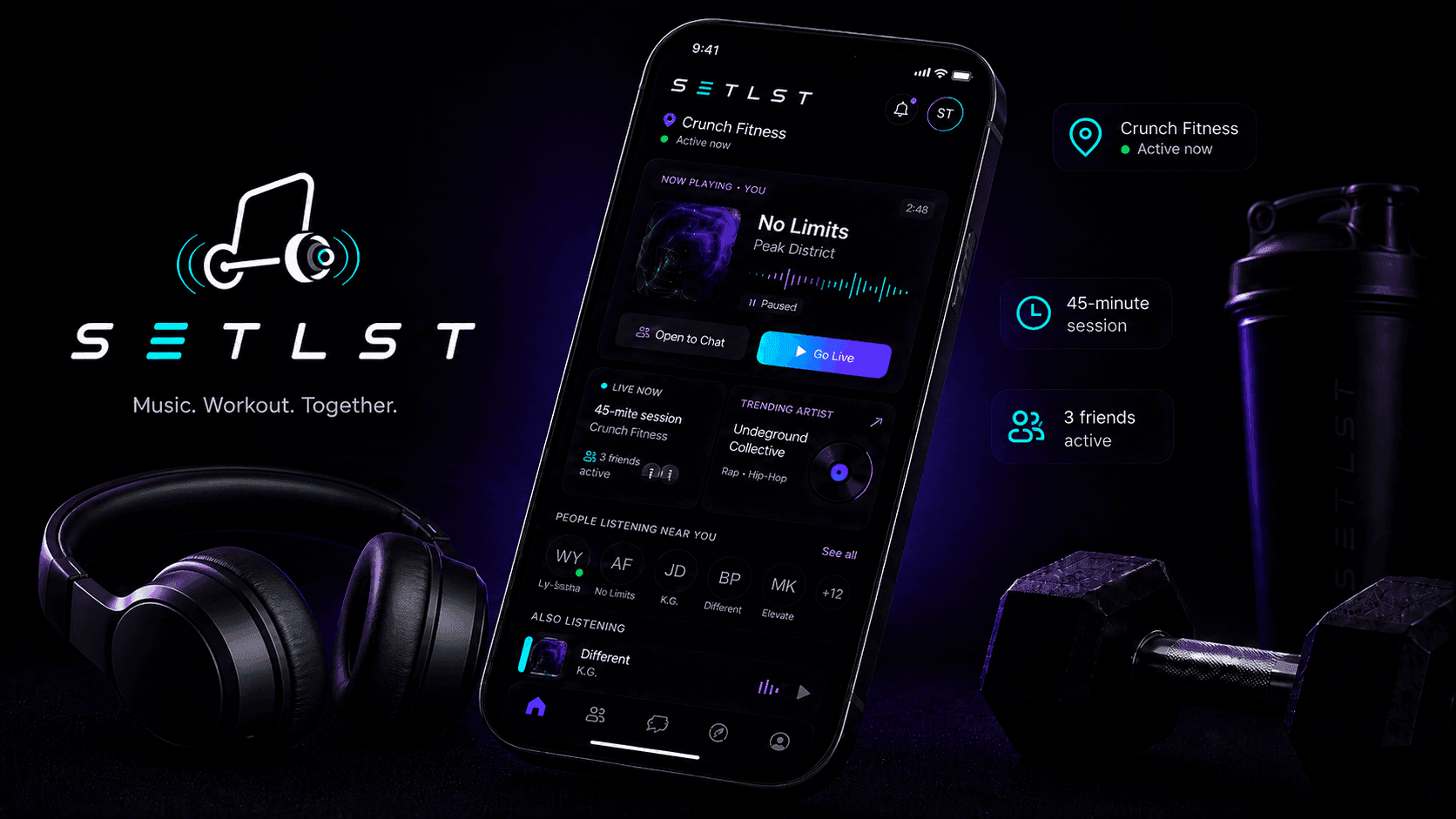
- Now-playing and live gym activity feed
- Friend requests and controlled messaging ideas
- Public or private workout streaks
- Forum and motivation feature concepts
- Early mobile dashboard and interaction prototypes
Design decisions
The brand mixes a dark gym interface with teal, blue, and purple accents. We wanted it to feel sleek and energetic without becoming a loud neon gaming interface.
The now-playing activity is treated as the main hook. Social features support that experience, but they stay quieter so the product does not immediately read as a dating app or a generic social network.
An Open to Chat control is intentionally subtle. The user should be able to signal availability without placing a large social label on themselves every time they enter the gym.
The name SETLST is intentional. It connects musical setlists with workout sets while using a shorter, more balanced spelling for the brand.
Technical decisions
The early product model is organized around users, gym presence, connected music activity, friendships, and workout consistency.
We stepped back from the original exact in-gym map for the first version because location privacy, safety, and liability would quickly become larger than the core product. A broader activity board can test the idea without exposing precise positions inside the gym.
The current React prototype is mainly being used to work through navigation, hierarchy, and interaction behavior before committing to a larger mobile build and specific music or location integrations.
Challenges
The biggest challenge has been deciding what the product really is. It can easily expand into a gym map, music feed, social network, forum, streak tracker, creator platform, and trainer marketplace all at once.
Privacy is the second major challenge. A feature that feels interesting on a concept board can feel very different when it reveals where a real person is standing, what they are doing, and whether they are open to being approached.
We have also had to keep checking whether each new social idea helps the workout experience or distracts from it.
The outcome
SETLST currently has a much clearer identity and product direction than the original map idea. We know the central experience should be music-driven gym activity, with social and consistency features supporting it.
Because the concept started with someone else, the work has been as much about turning another person's original idea into something more focused, presentable, and technically realistic as it has been about design.
What I'd improve next
The next step is to lock the smallest useful first version, validate it with people who actually train regularly, and prototype the privacy controls before investing in deeper location or music integrations.

Let's Talk
Want something like this for your business?
Whether it's a website, a system, or an idea that still feels a little messy, I can help you figure out what makes sense next.