


The short version
- 01
Taylor.io came directly out of my own job search. At first I was sending the same resume everywhere and mostly getting automated rejections. Once I started changing the story for each type of role, I felt like the responses became noticeably better, but every application also took much longer.
- 02
My process eventually became repetitive: read the job description, identify the strongest parts of my background for that role, use AI to improve the wording and emphasis, rebuild the resume, and submit it. After doing that for more than 150 resumes for myself and friends, it felt obvious that most of the workflow could be turned into a product.
- 03
The original idea was simple: sign in, explain your background, provide a role, and get a tailored resume. I kept expanding it with uploads, saved profiles, templates, previews, exports, and different tailoring controls until the scope started slowing me down. The biggest turning point was finally defining what a successful first version actually needed, finishing that version, and deploying it before it felt perfect.
The problem
Tailoring a resume can help, but the normal process is slow and scattered. The user reads a job description in one place, asks an AI tool questions in another, edits a document somewhere else, and repeats the same background information every time.
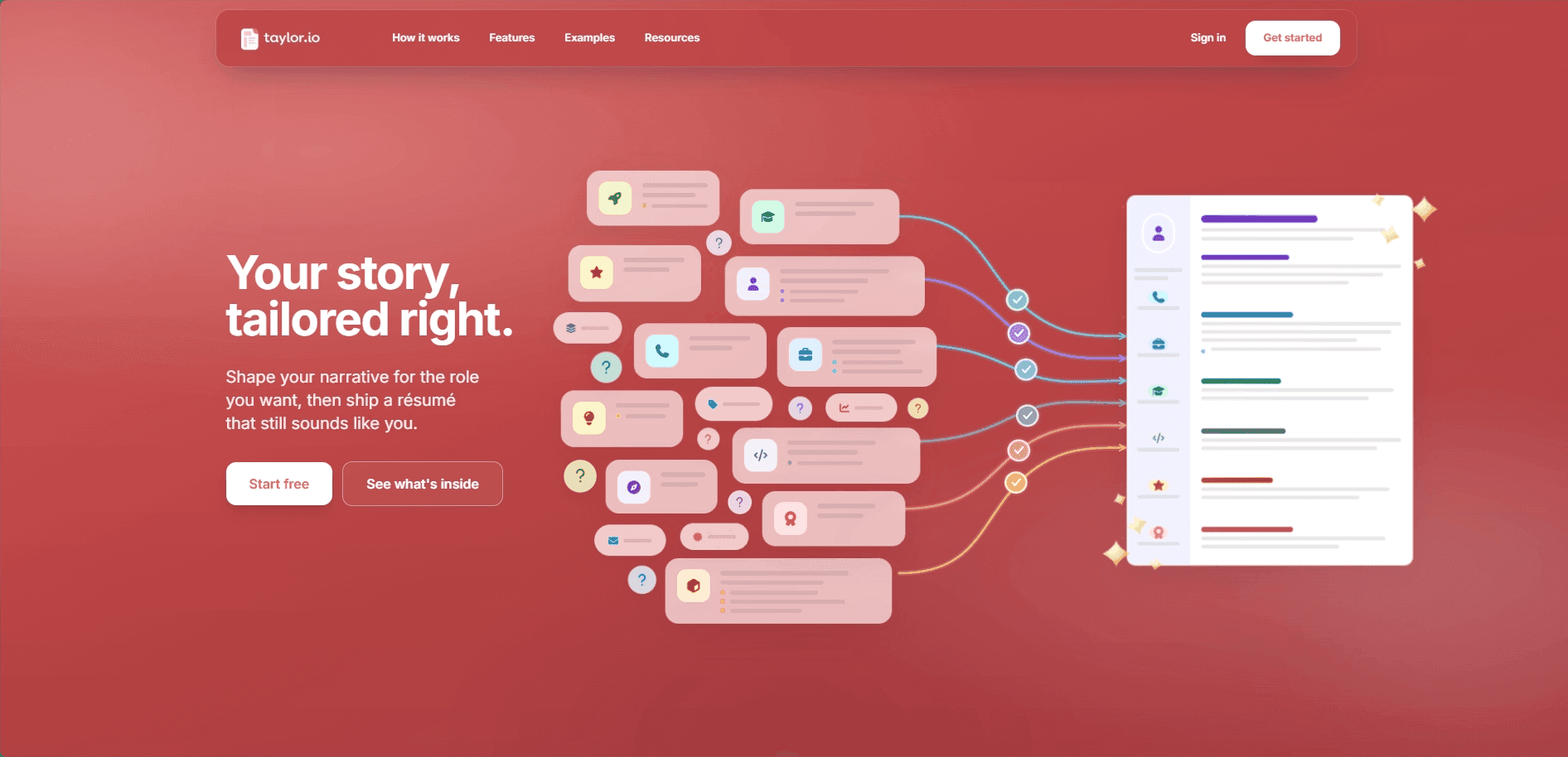
Most resume products also treat the resume like one block of text. I wanted the underlying career information to be structured, reusable, and able to shift without forcing the user to rebuild everything from the beginning.
What I built
- PDF and DOCX resume upload and extraction
- Structured resumeData profile model
- Job-description and role analysis
- Role-specific resume tailoring pipeline
- Section-based editor with live preview
- Saved profiles, authentication, and user data
- PDF and DOCX generation
- Review explanations showing what changed and why
Design decisions
I wanted the product to feel guided instead of opening on an empty document. Users should be able to see the story they already have, understand what the system is emphasizing, and make smaller decisions instead of rewriting the entire resume in one large text box.
The editor and preview stay connected because the final document still matters. The structured data is useful behind the scenes, but the user needs to see how those decisions actually change the resume a recruiter will receive.
I also started giving the AI output a clearer explanation layer. A suggestion is easier to trust when the user can see what was prioritized, what was trimmed, and where the system was intentionally being cautious.
Technical decisions
The core system is organized around structured resume data rather than a single generated document. Education, experience, projects, skills, and layout settings can be edited independently and reused across different versions.
FastAPI handles the parsing, tailoring, authentication, and export workflows. PostgreSQL stores user and resume data, while React powers the editor and preview experience.
The AI layer handles extraction, analysis, and drafting, but the output is constrained by the user's existing evidence so the product does not casually invent experience or replace the user's real stack with keywords from a job description.
Playwright and a separate DOCX builder handle the two export paths because a good browser preview does not automatically translate into a reliable editable document.
Challenges
The biggest product challenge was my own scope creep. Every useful idea made me want to add three more before I had proven the main flow.
The hardest system problem was balancing useful rewriting with strict truth. The product has to make a resume more focused without turning it into a confident list of things the person never actually did.
Document generation was another project by itself. A resume can look correct in the browser and still break once it becomes a PDF or DOCX file with different page, spacing, and font behavior.
The outcome
Taylor.io is now an early working product instead of an idea I keep redesigning privately. It can take existing resume information, structure it, tailor the presentation for a role, and export a usable document.
There are still imperfections, but shipping it turned a private redesign loop into a real system that can be tested, evaluated, and improved. It also became the clearest example of how I approach a product from the first frustration through the data model, interface, AI behavior, and deployment.
What I'd improve next
The next version needs a cleaner onboarding flow, stronger version comparison, and an easier way to move between a base profile and several tailored resumes.
I also want to keep improving the explanation and evaluation layers so users can understand why a change was made, catch weak suggestions quickly, and stay in control of the final story.

Let's Talk
Want something like this for your business?
Whether it's a website, a system, or an idea that still feels a little messy, I can help you figure out what makes sense next.