


The short version
- 01
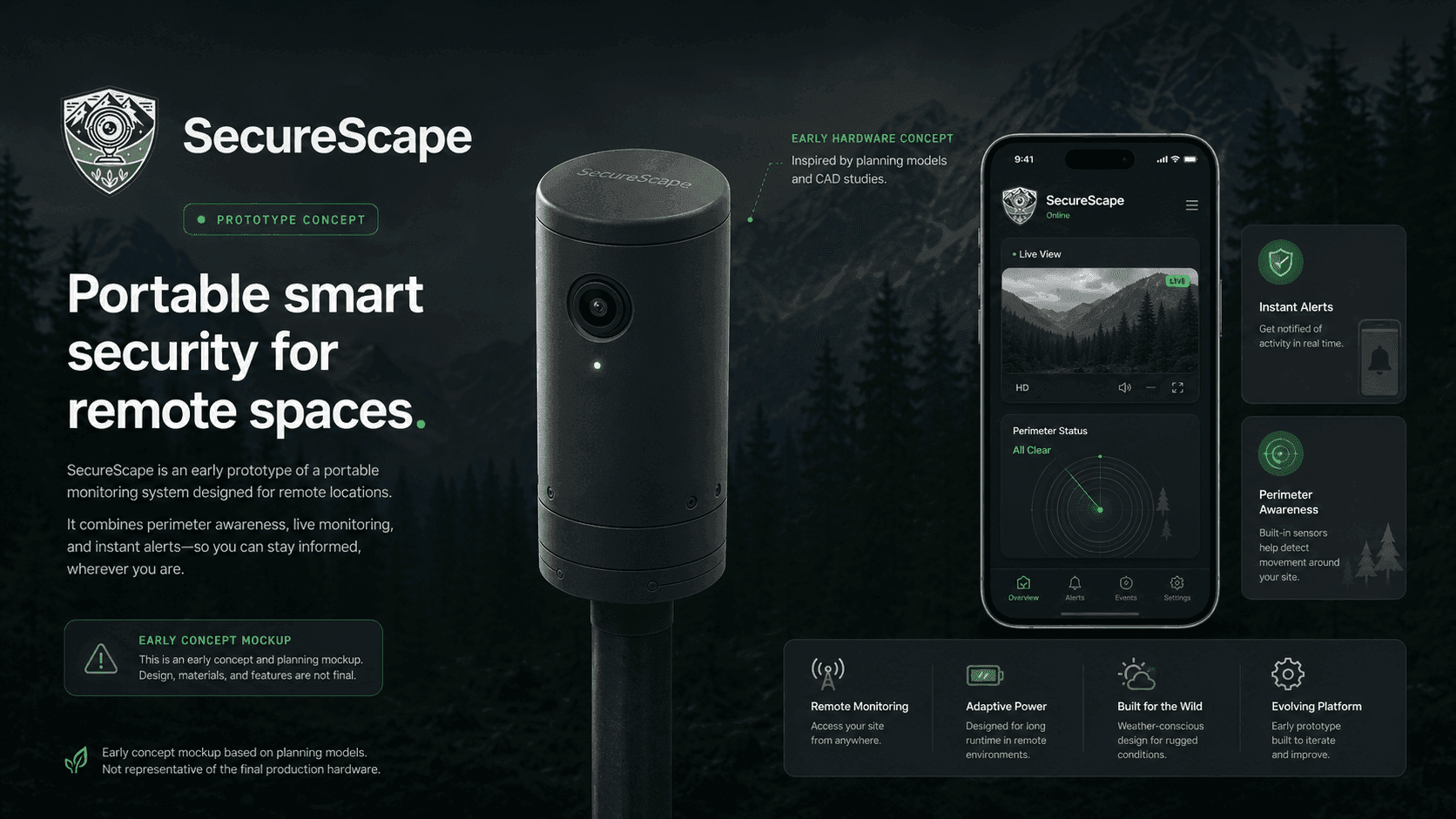
SecureScape was my senior design project at UCF. The idea was a portable security system made from small camera nodes that could be placed in a temporary environment, detect activity, and send controls and alerts back to a user.
- 02
My main work focused on the Flutter mobile app, the Python communication layer, and getting the hardware and software pieces to behave like one system during a live demonstration.
The problem
Traditional security systems are usually tied to a building and a permanent installation. We wanted to explore whether a smaller, portable setup could provide useful monitoring in spaces where installing a full system would not make sense.
The prototype had to prove the complete loop: detect something, communicate across devices, alert the user quickly, and provide controls that actually worked.
What the team built
My work focused on the Flutter app, Python communication layer, backend development, and system integration.
- ESP32-CAM security nodes
- Lightweight TensorFlow Lite detection model
- Flutter mobile controls for alarms, lighting, photos, and recordings
- Python backend and device communication layer
- React monitoring dashboard
- Near real-time alert flow
- Working end-to-end demonstration
Design decisions
We kept the user controls direct because the prototype was testing the system, not trying to redesign the entire home security market.
The live demonstration was treated as the main success criterion, so reliability of the core detection and alert flow mattered more than adding a long list of unfinished features.
Technical decisions
The detection model was kept small enough to run within the limits of the embedded hardware while still reaching useful accuracy in our team testing.
The Python communication layer coordinated the device and application behavior, while the Flutter app gave the user portable access to the main controls.
The working prototype completed the full detection-to-alert path within a few seconds.
Challenges
Hardware failures are rarely as clean as software errors. Connectivity, power, camera behavior, timing, and the physical environment could all affect a demo that looked stable in code.
A large part of the work was integration and repeated testing so one unreliable component did not break the entire experience.
The outcome
The team completed a working prototype that connected embedded cameras, local detection, backend communication, a mobile interface, and alerts in one end-to-end system.
The build spans hardware and software boundaries, where debugging means tracing the whole path from camera to detection to backend to phone rather than any one codebase in isolation.
What I'd improve next
A production version would need stronger hardware enclosures, better battery behavior, more reliable networking, hardened device security, and much more testing outside a controlled demo environment.

Let's Talk
Want something like this for your business?
Whether it's a website, a system, or an idea that still feels a little messy, I can help you figure out what makes sense next.